 Cento
Invest your discounts: how small savings grow over time
How CresCENTO in Cento keeps track of the money you save on discounts, what that money can become over the years, and how I invested mine.
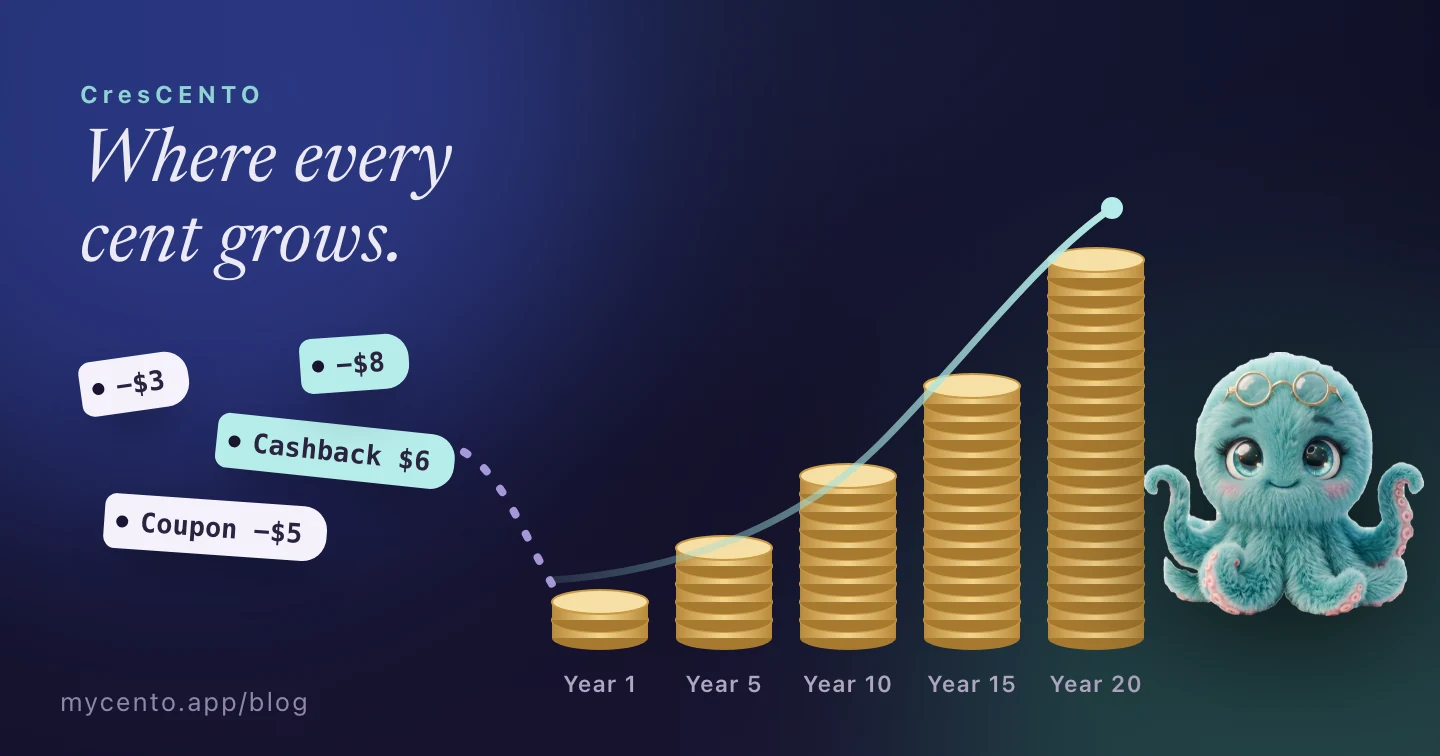
When I find a better price, I save a few dollars. If I don’t do anything with that money, it stays in my account and gets spent on other things, and after a while I can’t say where it went.
CresCENTO is the part of Cento that keeps track of these savings. Every discount goes into a separate pool, and when the pool is big enough, I invest it. In this article I explain how it works, what small amounts can become over the years, and what happened with my own pool.
Why discounts are easy to invest
When I go shopping, I have a price in mind. If something costs $50 and I find it for $42, I was already prepared to pay the $50. The $8 difference is money I had already counted as spent.
That’s why setting it aside doesn’t change anything in my month. Rent, groceries and bills stay the same, and the discount goes into the pool.
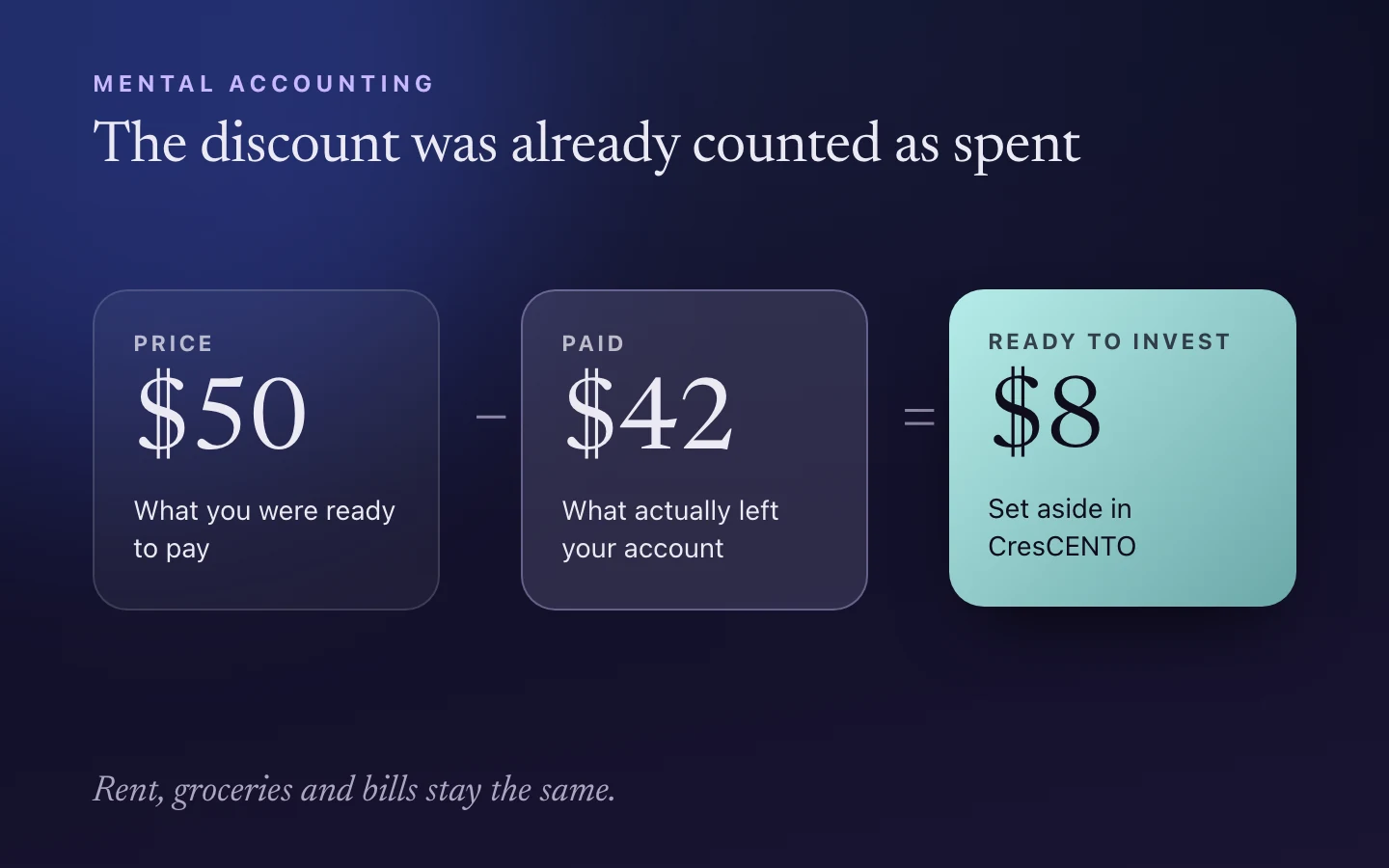
Economists call this mental accounting. Richard Thaler, who later received the Nobel Prize in economics, showed that people split their money into separate mental categories, such as rent money, holiday money or found money, and treat each category differently. CresCENTO uses this on purpose: discounts get their own category, labelled “to invest”.
What small amounts become over time
One discount is a small amount. The total grows with every month, and once it’s invested, it can also grow on its own.
As an example, say your discounts, coupons and cashback add up to $25 a month, a little under a dollar a day. This is what it becomes over time:
| After | Kept aside, 0% | Growing at 5% a year | Growing at 7% a year |
|---|---|---|---|
| 5 years | $1,500 | $1,700 | $1,790 |
| 10 years | $3,000 | $3,882 | $4,327 |
| 20 years | $6,000 | $10,276 | $13,023 |
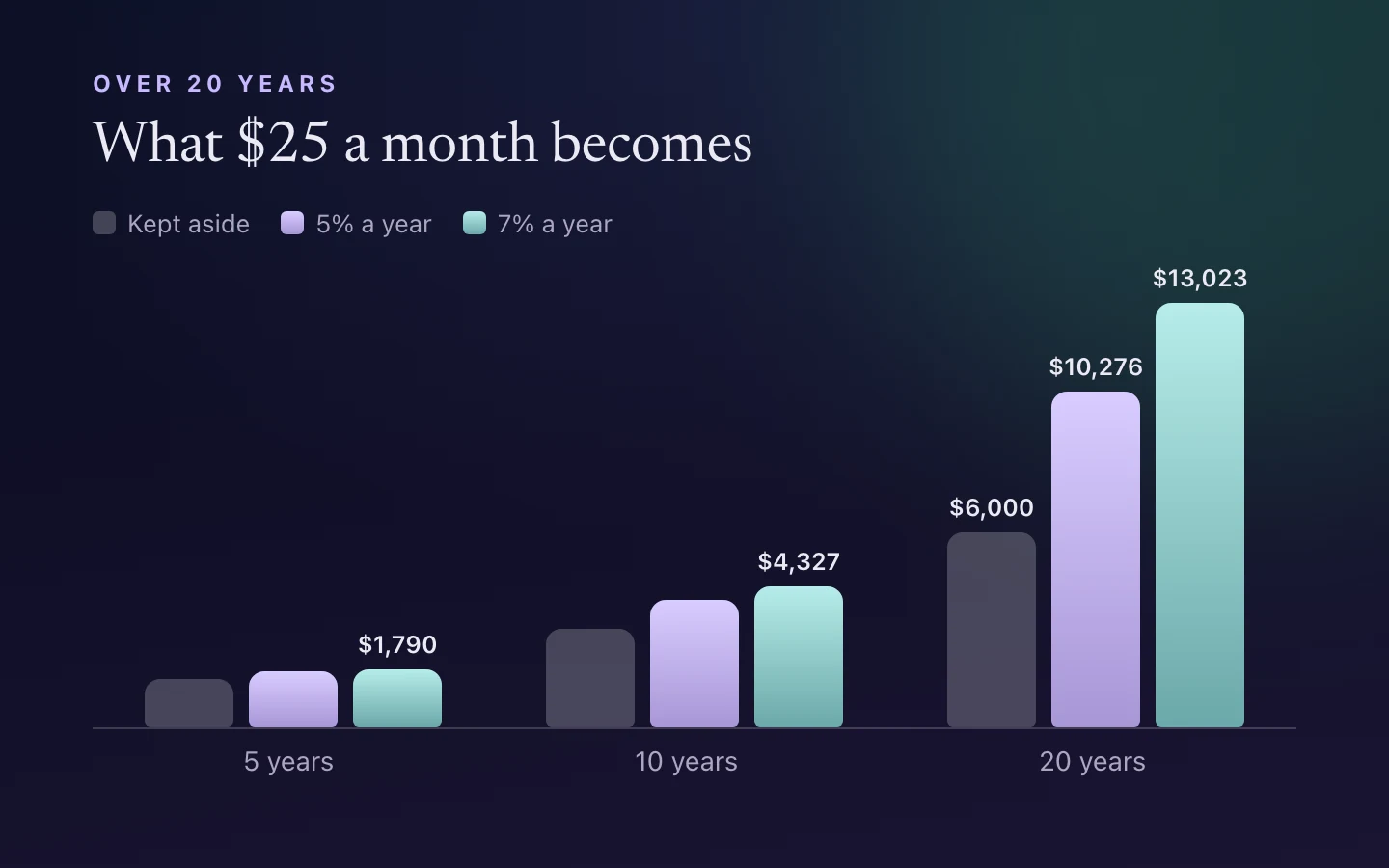
Kept aside with no growth at all, the discounts add up to $6,000 in 20 years. At 7% a year, more than half of the $13,023 comes from growth, and the share from growth gets bigger the longer the money stays invested. This is compounding: the returns also earn returns, and the effect builds with time.
The rates in the table are only an illustration. Real investments go up and down, some years end with a loss, and nobody can guarantee a return. Prices also rise over 20 years, so $13,000 will buy less then than it does today.
My own example: AMD
I tracked my discounts with CresCENTO, and when the pool had grown, I invested the money in AMD shares. At the time of writing, the investment is up about 150%.
I know I can also lose this money. The shares of a single company can drop a lot and stay low for years.
For me, this money was already spent. If I hadn’t searched for the best price, I would have paid the full amount and I wouldn’t have had it anyway. So if I lose it, it doesn’t affect me psychologically, and if it grows, I’m happy :)
This is my personal experience and I’m sharing it as an example. It’s no recommendation to buy AMD or any other share, and past gains say nothing about future results.
The same feeling can lead to bigger risks
Richard Thaler and Eric Johnson studied how people decide after a gain. They found that people take bigger risks with money they see as a bonus, and called this the house money effect.
It helps in one way: investing discounts feels easier to start than investing from my salary. It can also lead to risks I wouldn’t take with other money, and the money is just as real.
A few things I keep in mind:
- I decide where the money goes before I invest it. Some people choose a broad index fund that holds many companies, some keep the money in a savings account, and some choose one company they believe in. A single company carries much more risk than a fund that holds hundreds.
- I think in years. Compounding needs time, and an investment that drops needs time to recover.
- I only invest money I won’t need soon. The emergency fund and next month’s bills stay in a safe place.
- When I’m unsure, I ask a professional. Cento keeps track of the pool and doesn’t give investment advice. This article isn’t investment advice either.
How CresCENTO works
The hard part is remembering every discount: $3 off in one shop, a coupon in another, cashback that arrives a week later.
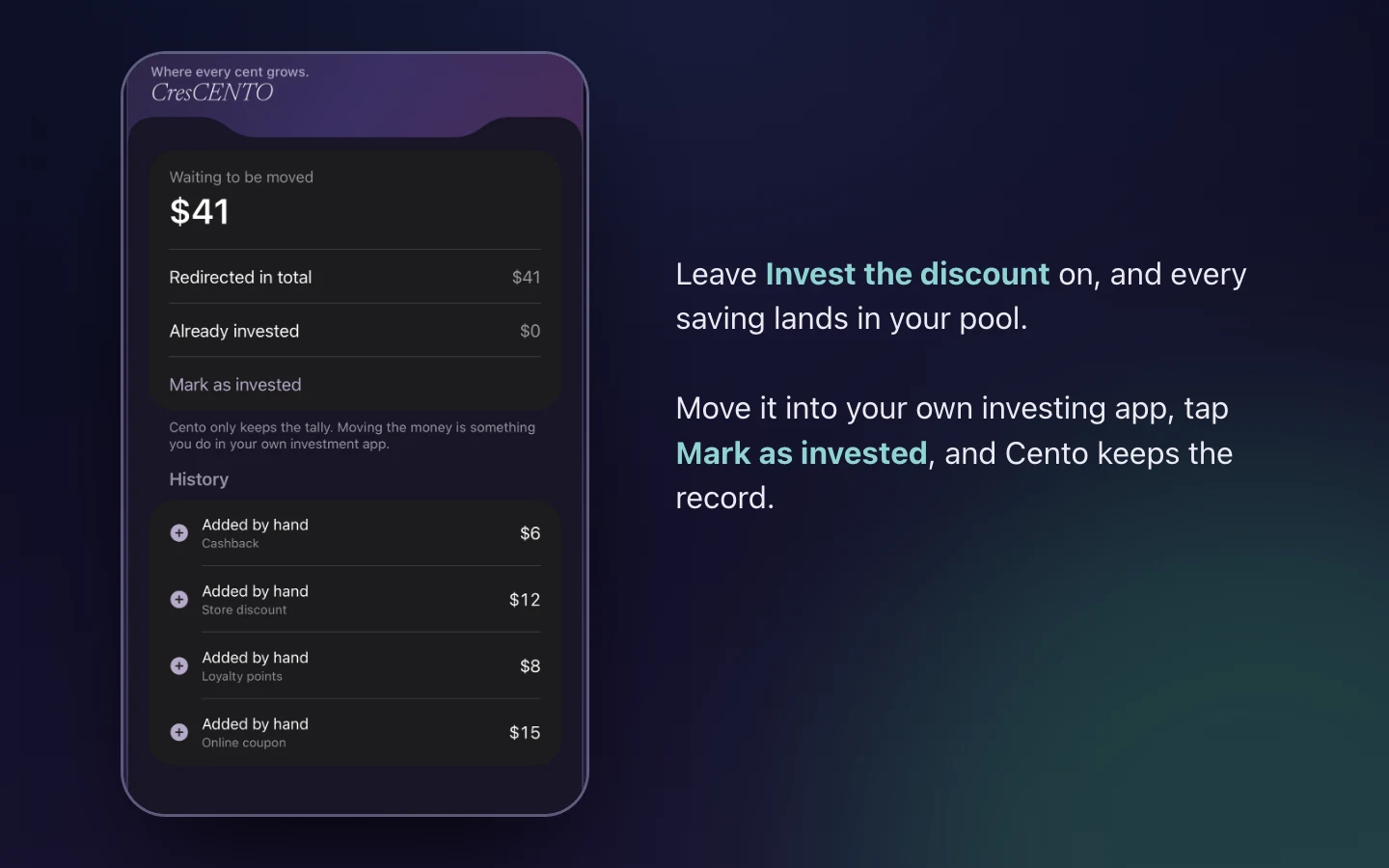
Cento keeps the list for you. When you scan a receipt or add an expense with a discount, leave Invest the discount on, and the saving goes into your CresCENTO pool, ready to invest. You can add cashback, loyalty points and online coupons by hand with the + button.
When the pool is big enough for you, move the money into your own investing or savings app. Cento doesn’t move any money. After you move it, tap Mark as invested, and Cento keeps the record: how much you’ve set aside in total, how much you’ve already invested, and every discount in the history.
CresCENTO is part of Cento Premium. In a shared household, everyone’s discounts go into the same pool.
Sources
- Thaler, R. H. (1985). Mental accounting and consumer choice. Marketing Science, 4(3), 199-214. doi.org/10.1287/mksc.4.3.199
- Thaler, R. H. (1999). Mental accounting matters. Journal of Behavioral Decision Making, 12(3), 183-206. doi.org/10.1002/(SICI)1099-0771(199909)12:3<183::AID-BDM318>3.0.CO;2-F
- Thaler, R. H., & Johnson, E. J. (1990). Gambling with the house money and trying to break even: The effects of prior outcomes on risky choice. Management Science, 36(6), 643-660. doi.org/10.1287/mnsc.36.6.643